How to Create Raised Gravel Beds for Those with Limited Reach or Strength
Get an estimate for your project in 60 seconds
 Your information is secure
Planning a garden that works for people with limited reach or strength requires different specifications from standard raised beds. Height, width, access routes, and base materials all need adjustments to ensure comfortable gardening without excessive bending, stretching, or strain. Gravel plays two distinct roles in accessible raised bed projects. It provides drainage and support beneath the beds while also forming stable pathways between them when properly compacted.
The construction requires durable materials, proper spacing between beds, and careful attention to reach distances for those with limited mobility.
What Height Works for People with Limited Mobility?
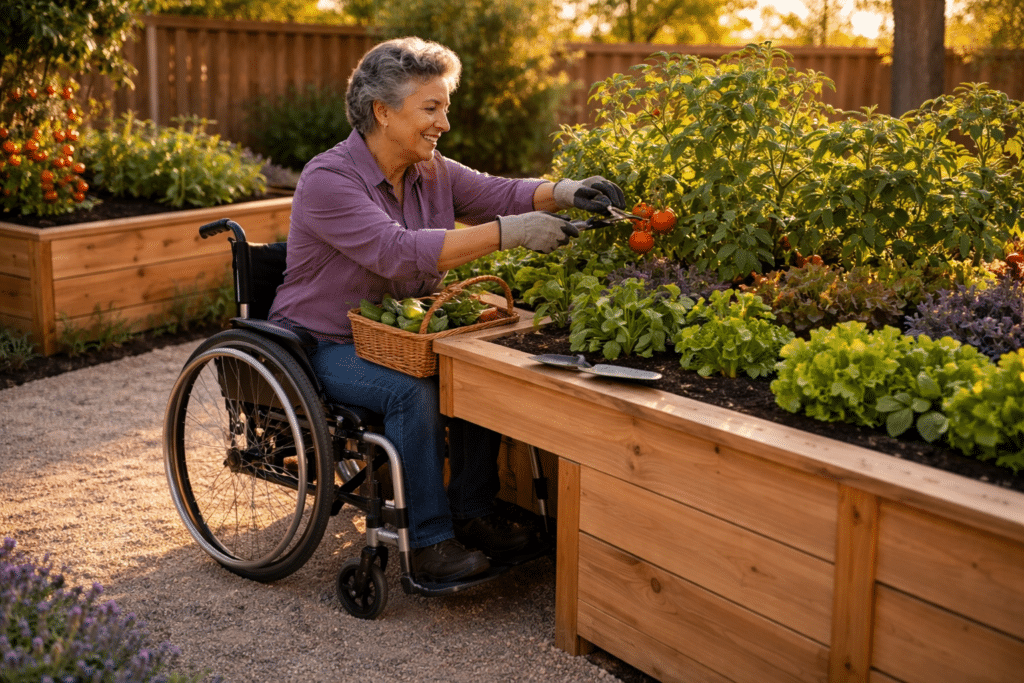
The standard height for wheelchair-accessible raised beds ranges from 24 to 30 inches. This elevation allows someone seated to reach into the bed without straining. For individuals who garden while standing but have difficulty bending, beds at 30 inches reduce the need to lean forward significantly. Beds designed for children or shorter adults may work better at 20 inches. The key measurement is from the ground to the top edge of the bed, not to the soil surface inside.
Some designs include a forward approach where the bed has a recessed area underneath. This allows a wheelchair to roll partially under the bed, bringing the person closer to the plants. For these designs, the recessed area needs at least 27 inches of clearance from the ground.
How Wide Should Accessible Raised Beds Be?
Width determines whether someone can reach the center of the bed from a seated or standing position. For beds accessible from one side only, the maximum width should be 24 inches. This ensures the back of the bed remains within arm’s reach.
Beds accessible from both sides can extend up to 48 inches wide, since each side provides 24 inches of reach. Most accessible designs stay between 36 and 48 inches wide when both sides are open. Length is less critical but beds between 4 and 8 feet long are common. Longer beds work fine as long as pathways allow someone to move along the entire length without obstruction.
What Kind of Gravel Goes Under the Raised Bed?
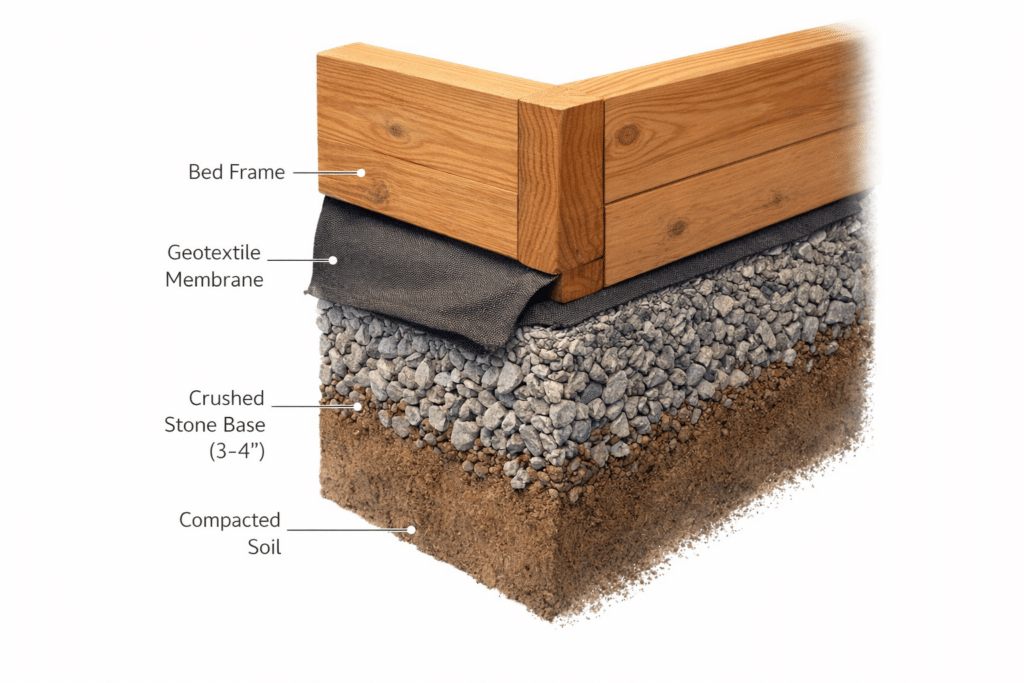
A gravel base beneath raised beds improves drainage and creates a level foundation. The gravel layer prevents water from pooling under the bed and protects the bed frame from direct contact with soil, which can accelerate rot in wooden structures.
A 3 to 4 inch layer of crushed stone works well for this purpose. Crushed stone compacts more firmly than round gravel, creating a stable base that resists shifting. Materials like three-quarter-inch minus gravel compact well and provide effective drainage.
For beds placed on hard surfaces like concrete or existing gravel, the Royal Horticultural Society recommends at least 3 inches of coarse gravel beneath the bed. A geotextile membrane over this gravel layer prevents soil from mixing into the drainage material while still allowing water to pass through.
Inside the bed, gravel at the bottom is optional. Most accessible beds are deep enough that filling entirely with soil works better for plant roots. If the bed is very deep and cost is a concern, 6 inches of gravel at the bottom can reduce the amount of soil needed, but a barrier fabric should separate the gravel from the soil above.
What Pathway Material Supports Wheelchairs and Walkers?
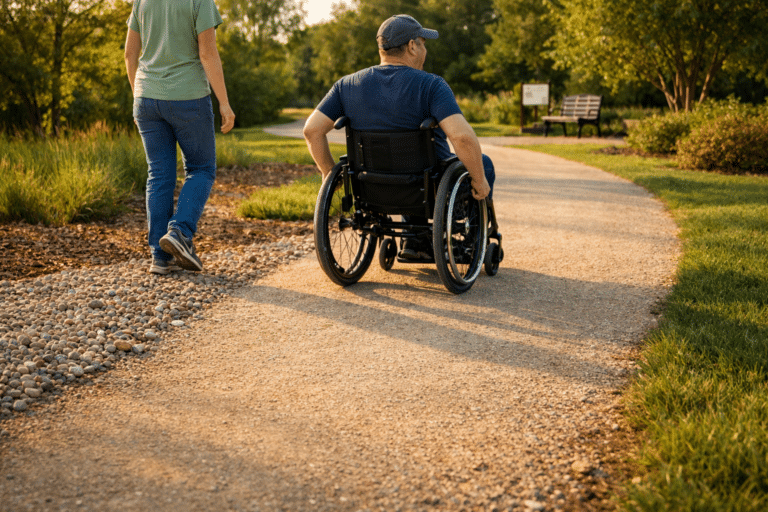
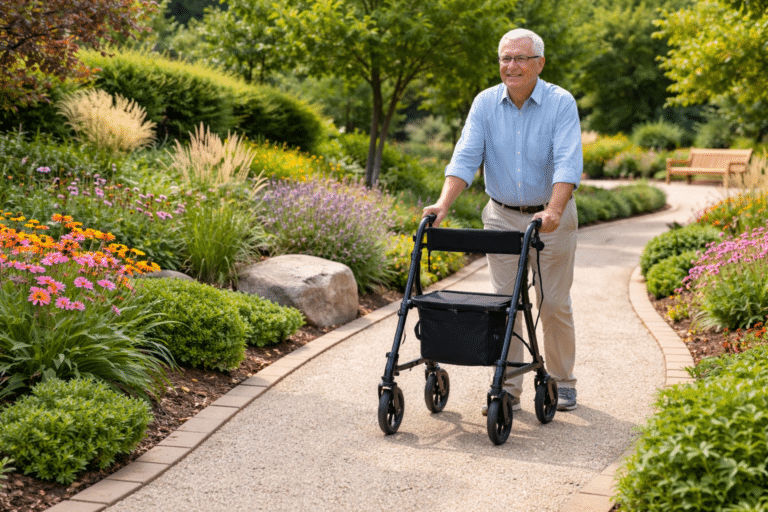
Pathways between raised beds require a firm, stable surface. Loose materials like pea gravel or deep gravel create resistance that makes wheelchairs difficult to push and can cause walkers to sink or slide.
Properly compacted crushed stone provides a wheelchair-accessible surface. The material needs to be angular rather than round. Quarter-inch minus gravel, which includes fine particles down to dust, compacts into a cement-like surface when wet and rolled.
A standard installation uses 4 inches of five-eighths-inch minus gravel as a base layer, followed by 2 inches of quarter-inch minus gravel on top. Both layers are compacted with a plate compactor. The finer top layer creates the smooth, firm surface needed for wheelchair access.
Note: Concrete and asphalt also work well for accessible pathways but cost more and are less permeable. Decomposed granite, when stabilized with a binder product, provides a natural-looking alternative that meets accessibility standards.
How Much Space Do You Need Between Beds?
Pathways between accessible raised beds should be at least 48 inches wide. This width allows wheelchairs, walkers, and wheelbarrows to pass through comfortably. Wider pathways of 60 inches provide room for a wheelchair to turn around without backing up.
At intersections where pathways meet, a turning radius of 60 inches in diameter is recommended. This space allows someone in a wheelchair to change direction without multiple back-and-forth movements.
Sloped pathways require additional consideration. The maximum slope for accessibility is 5 percent, which equals 1 inch of rise for every 20 inches of length. Steeper slopes need ramps with a maximum grade of 8.33 percent and handrails on both sides for safety.
Do Drainage Details Matter with Raised Gravel Beds?
Raised beds need drainage holes to prevent waterlogged soil. Holes spaced 12 to 18 inches apart along the bottom of the bed allow excess water to escape. Without drainage, roots can suffocate and plants will struggle.
The soil mix itself affects drainage. A blend of topsoil, compost, and a porous material like perlite or coarse sand drains more effectively than heavy garden soil alone. Well-draining soil prevents water from pooling even during heavy rain.
For beds on concrete or other impermeable surfaces, consider placing the drainage holes slightly above the bottom edge rather than at the very bottom. This creates a small water reservoir that prevents the soil from drying out too quickly while still allowing excess water to drain.
How Do You Calculate Gravel Quantities?
Gravel is sold by the ton or cubic yard. To calculate how much you need, measure the area in square feet and multiply by the depth in feet. Divide by 27 to convert cubic feet to cubic yards. For a pathway 4 feet wide and 20 feet long with 6 inches of gravel, the calculation is 4 times 20 times 0.5 feet equals 40 cubic feet. Dividing by 27 gives approximately 1.5 cubic yards.
Ordering 10 to 20 percent extra accounts for compaction and uneven areas. Gravel compacts when rolled, so the final depth will be less than the loose material depth. Extra material also helps fill low spots and ensures complete coverage.
Once you have your measurements and material requirements calculated, ordering the right type and quantity of gravel makes building accessible raised beds straightforward. Hello Gravel simplifies the process of sourcing crushed stone, gravel, and other bulk materials for your project. Contact Hello Gravel today for your bulk purchases and material orders.
Frequently Asked Questions
Can you build raised beds directly on top of existing gravel?
Yes, existing gravel provides drainage and a level base, though you should check what material lies beneath it.
What is the maximum comfortable reach from a wheelchair?
Most people can comfortably reach 24 inches from a seated position without straining.
How often do compacted gravel pathways need maintenance?
Compacted pathways may need regrading or additional gravel every few years to maintain a smooth surface.
What gravel size works best for pathways between beds?
Quarter-inch minus gravel compacts into a firm, smooth surface suitable for wheelchairs and walkers.
Do elevated beds need to be structurally certified?
Commercial installations may require structural certification to ensure they can withstand soil weight and people leaning on them for support.
What is the difference between crushed stone and pea gravel for pathways?
Crushed stone has angular edges that lock together when compacted, while pea gravel remains loose and unstable for wheelchairs.

 Chance Kittrell